
FREE Webinar Series: Investigating the Climate Crisis with Results
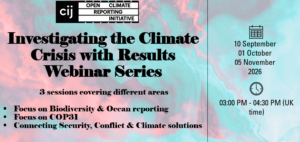
Thurs Sept 10, Oct 1 & Nov 5, 2026
3pm-4:30pm (UK Time)
This 3-series webinar brings to the fore specific areas needed for journalists and researchers to move from typical reporting of environmental and climate events to investigations that drive impact.
Over the last four years, we’ve learned a lot about how journalism can get results in pushing for climate progress and addressing injustice. Through the Open Climate Reporting Initiative (OCRI) we’ve empowered hundreds of frontline reporters in 58 countries with cutting edge skills for investigative research and compelling stories.
Join us to hear more from carefully selected expert speakers who will share their knowledge in biodiversity and ocean reporting, essential preparation for covering COP, and methods to connect security, conflict & climate solutions. This webinar series builds on our January webinar From Skills to Shifts: How Climate Investigations Get Results and you’ll gain a deeper understanding of what it takes to interrogate certain thematic areas towards enabling accountability and action while staying ahead in the discourse.
Thurs Sept 10, 2026 3pm-4:30pm (UK Time)
Focus on Biodiversity & Ocean reporting
The first session in the series focuses on biodiversity and ocean reporting. It will provide an overview of the international governance framework of the Convention on Biological Diversity (CBD) and practical steps for journalists to report on, especially around finance and human rights in preparation for the CBD COP17 holding from October 19 to 30, 2026 in Armenia.
With Jessica Aldred, Senior Editor, Ocean Investigations, Pulitzer Center.
Done!
Presentation slide download: Jessica Aldred – Focus on Biodiversity & Ocean reporting
Thurs Oct 1, 2026 3pm-4:30pm (UK Time)
Preparing for COP31
The session will set out the current state of policy structures and intergovernmental debate, by giving practical tips and advice for preparations as well as the best practice for reporting during COP31 happening in Türkiye from November 9-20 whether in attendance or remotely.
With Lina Yassin, Climate Diplomacy Researcher, International Institute for Environment and Development (IIED).
Thurs Nov 5, 2026 3pm-4:30pm (UK Time)
Connecting Security, Conflict & Climate Solutions
The last session of the series will provide participants with tips and techniques to connect every other journalism beat to climate change using security and conflict as case study angles to report the climate crisis from. It will also emphasise how to use a constructive, ethical and evidence-based solutions approach to climate investigations by helping participants write about the climate crisis with contextual honesty, while avoiding leaving their audience feeling hopeless and disempowered.
With Tais Gadea Lara, Climate Change journalist and Adeolu Adekola, Project Manager, OCRI.
Speakers
Adeolu Adekola, OCRI Project Manager, CIJ
Jessica Aldred, Senior Editor, Ocean Investigations, Pulitzer Center
Lina Yassin, Climate Diplomacy Researcher, International Institute for Environment and Development (IIED)
Tom Sanderson, Deputy Director, CIJ
Tais Gadea Lara, Climate Change journalist
Register below to book your place. The registration gives you access to all three webinars.
Please note that, to receive the joining details for a particular session, you must register by 12 noon (UK time) on the day of that session. If you register after the deadline, you will still receive joining details for the remaining webinars in the series.
Adeolu Adekola
Jessica Aldred
Lina Yassin
Tais Gadea Lara
Tom Sanderson
Registration form
- 10 September 2026 15.00–16.30 GMT (UK time)
- 1 October 2026 15.00–16.30 GMT (UK time)
- 5 November 2026 15.00–16.30 GMT (UK time)
From Skills to Shifts: How Climate Investigations Get Results
Jan 29, 2026 3pm-4:30pm (UK Time) You can download slides from each of the speakers below: Maximiliano Manzoni - Climate Journalism - Lessons from Latam Syed Nazakat - Addressing Climate Misinformation - Now and Beyond Adeolu Adekola - OCRI Impact Summary Over the last four years, we’ve learned a lot about how journalism can get results in pushing for climate progress and addressing injustice.
Climate Investigations Course: All Modules
Open Climate Reporting Initiative
Climate change is a multi-faceted problem in which the issues at play are interlinked and complex, running across many different fields; scientific, financial and political. Finding solutions requires an understanding of these issues that can be facilitated through access to high-quality, trusted information and the ability to construct compelling narratives.