
Can investigative journalism make a difference in an age of climate crisis?
By Tom Sanderson and Adeolu Adekola
As we face a planet-wide crisis of enormous and incredibly complex proportions, the growing realisation of the situation’s gravity has mobilised vast sums of money. Inevitably this brings vested interests and opportunities for unscrupulous actors. Investigations in the public interest remain essential to underpin sufficient scrutiny and effective action.
While technological progress and sustainable development play a vital role in achieving a human future beyond the current crisis, regulatory bodies and intergovernmental organisations must navigate a maze of political and corporate influence. Wrong turns can leave them underfunded and without the necessary research expertise.
Investigative journalists and civil activists help fill this gap. They have contributed crucial findings on a range of issues to support climate finance and action going where it is needed and having the intended impact. Without independent research, governmental and philanthropic funds risk huge amounts of both waste and corruption at a time when the planet can afford neither.
Over the last four years, the Open Climate Reporting Initiative (OCRI) has empowered more than 700 journalists to go deeper in their climate reporting.
Without independent research, governmental and philanthropic funds risk huge amounts of both waste and corruption at a time when the planet can afford neither.
Now with over 5000 beneficiaries across 58 countries, OCRI is showing that investigating climate change doesn’t just matter; it is vital for improving how authorities act and how policies – local, regional and international – are shaped.
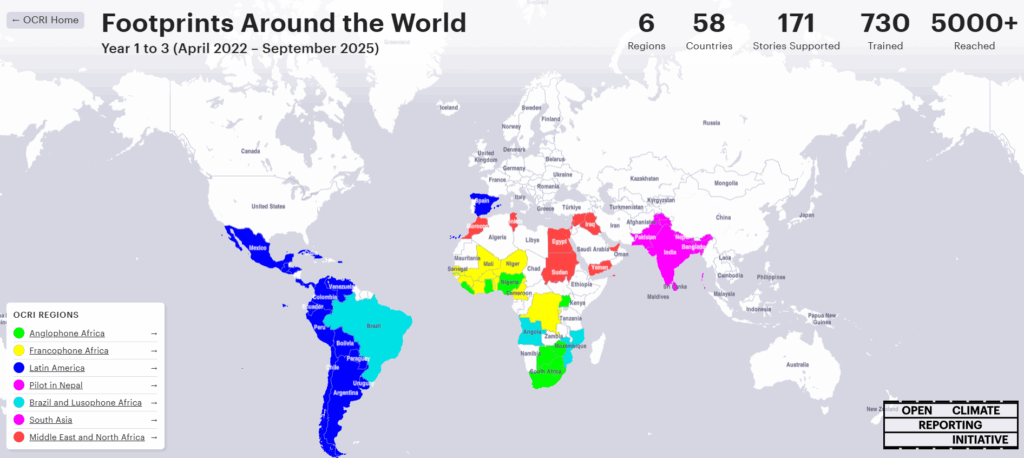
Participants have gained new skills and networks, and used them to expose uncomfortable stories that point to three key areas where investigating climate change has positive results:
1) Tracking climate finance and ensuring transparent use:
Pledges, commitments and initiatives have become mainstays by governments and corporations, whether at global gatherings like the UN’s annual Conference of Parties (COP) or locally as part of proposed plans. These regularly come with allocation of vast amounts of money with potential misappropriation or outright misuse.
The #PowerTracker project kicked off as an OCRI collaboration with Oxpeckers Center for Investigative Environmental Journalism. Within the first year, the project published 200 data points of renewable energy projects representing over $6.5 billion in five Southern Africa countries. With boots on the ground, investigative journalists tracked renewable projects in the region and sought answers to questions like how promises and plans for a $15-billion Lesotho wind farm project vanished.
In its second year, #PowerTracker liberated datasets on solar energy in Mozambique that tracked more than 60 projects being implemented by the National Energy Fund (FUNAE) between 2022 and 2030 in all provinces of the country. Journalists reported community scepticism trailing solar projects valued at $57 million in the Cabo Delgado province in northern Mozambique alone.
2) Driving justice and equity:
Climate actions could have good intentions but lead to bad outcomes. This may be a result of powerful corporate interests influencing state actors with disregard to environmental hazards or weaknesses in regulatory frameworks.
Being able to tell these stories and bring firsthand experiences to the fore builds evidence to support justice. This includes reporting illegal miners on the border of Brazil and Guyana threatening indigenous people in the Raposa Serra do Sol territory. And the stories of Tamil women in Sri Lanka, particularly war widows and mothers of the disappeared, struggling to reclaim their land while battling erratic weather patterns which have made farming nearly impossible, pushing them into deeper economic hardship.
Digging deep into vested interests behind community experiences is key. Whether in the form of the Jari carbon credit project deceiving communities and invading public lands in Brazil with corporates such as BMW, Banco BTG Pactual, and Telefônica Brasil benefiting from it. Or the exposé of how a mining company in The Gambia is destroying the environment, displacing communities and evading accountability due to political ties.
IIndependent investigative journalism is not just about highlighting what’s going wrong, it’s already empowering communities to force change. This includes the official return of 40.7 acres of land to civilian ownership in Sri Lanka and facilitating a petition to The Gambia Ministry of Petroleum, Energy and Mines.
3) Centring communities and protecting ecosystems:
The climate crisis is compounding inequalities for marginalised communities across the world and where they struggle to be heard by authorities, investigative journalism can help to raise concerns on their behalf.
Pilot work then reporting through OCRI exposed real estate and housing companies encroaching the Balkhu riverside in Nepal triggering high risks of flooding. This caused the regulatory agency to issue a directive for removal of the illegal structures endangering the riverbanks.
Reporting in Bangladesh revealed how the population of Kutubdia has shrunk by about 60,000 in 30 years as tidal surges and seasonal storms have swept away homes and landmass from the coastal region. Similar scenarios ensue where biodiversity is threatened – in Uganda where sand mining has affected fish breeding in Lake Victoria and in Egypt where more than 30,000 fishermen in Lake Manzala are being forcefully displaced due to the serious environmental impacts of a project implemented by the Egyptian government.
Designing and implementing effective and inclusive approaches that will provide the breakthroughs needed to tackle climate change is a global, multi-faceted effort. Governments, funders and regulatory bodies need the full picture of what is working, loopholes and vested interests must be stopped and communities must be heard. Independent investigative research and reporting is a key part of arming everyone – from politicians to lawyers to communities – with evidence and experiences to support this.
Investigating the climate crisis is not without risk. Powerful vested interests and authoritarian regimes threaten to stifle independent media with journalists in all regions facing safety and source protection concerns. Calculated, well-funded agendas to obstruct climate action are also on the rise, escalating disinformation on a grand scale.
Independent investigative research and reporting is a key part of arming everyone – from politicians to lawyers to communities – with evidence and experiences to support this.
But we know through our work with OCRI that despite this, investigative journalism continues to make a difference. Ensuring funds are going where needed and responses are having the intended impact. Empowering communities to act and push back on injustice. And providing scrutiny, including asking tough questions on authenticity and results of proposed solutions such as carbon offsetting, sustainable air fuel, ‘blue’ hydrogen or carbon capture and storage.
We’ve learnt so much about what is possible when we upskill journalists, build networks, share published stories, drive policy shifts and empower climate resilient communities – and there’s so much more to come. Which is why we’re committed to continuing this interconnected, agency-building work.
Join us now as a participant, partner or funder. It’s all hands on deck!
From Skills to Shifts: How Climate Investigations Get Results
Jan 29, 2026 3pm-4:30pm (UK Time) You can download slides from each of the speakers below: Maximiliano Manzoni - Climate Journalism - Lessons from Latam Syed Nazakat - Addressing Climate Misinformation - Now and Beyond Adeolu Adekola - OCRI Impact Summary Over the last four years, we’ve learned a lot about how journalism can get results in pushing for climate progress and addressing injustice.
Climate Investigations Course: All Modules
Climate Investigations Training Scholarship 2026
Applications for the 2026 Climate Investigations Training Scholarship are now closed. The CIJ is offering a Climate Investigations Training Scholarship in 2026. We're looking for 10 experienced journalists who want to upskill and use investigative techniques to produce deeper and more impactful climate-focused investigations. In January 2025 we launched the Climate Investigations Course (CIC).
Open Climate Reporting Initiative
Climate change is a multi-faceted problem in which the issues at play are interlinked and complex, running across many different fields; scientific, financial and political. Finding solutions requires an understanding of these issues that can be facilitated through access to high-quality, trusted information and the ability to construct compelling narratives.