
Can a Story Change a Law? What We Learnt Reporting on Climate in West Africa
By Akintunde Babatunde (Nigeria)
Since 2022, the partnership between the Open Climate Reporting Initiative (OCRI) of the Centre for Investigative Journalism and the Centre for Journalism Innovation and Development (CJID) has generated value that extends far beyond training journalists in Anglophone Africa and publishing climate investigative stories. It has shaped public discourse, strengthened civil society advocacy, and contributed to concrete policy and institutional responses to climate change in Nigeria and across West Africa.
Perhaps most visibly, sustained climate reporting ensured that the climate crisis entered mainstream political campaign discourse for the first time during Nigeria’s 2023 general elections.
In Nigeria alone, the first year of OCRI-supported climate investigations produced seven in-depth stories in 2022 that sustained national attention on climate governance at a time when political focus was elsewhere. This sustained pressure created an enabling environment for civil society organisations and policy advocates to intensify engagement with government, culminating in the formal inauguration of Nigeria’s Climate Change Council in September 2022 — nearly a year after the Climate Change Act had been signed into law. The journalism did not act in isolation, but it served as a steady public evidence base that civil society could reference in demanding institutional action.
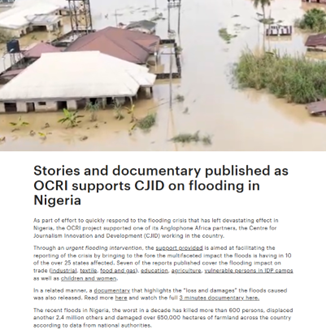
The impact deepened in 2022 and early 2023 through a second wave of reporting. Fourteen additional flooding investigations, supported by a documentary and a national Climate Change Media Summit, helped frame flooding not just as a seasonal disaster but as a governance, planning, and early-warning failure. These reports triggered formal responses from the Nigerian Meteorological Agency (NiMet) and fed into national and international advocacy conversations at COP27 in Egypt, where the global Loss and Damage Facility was agreed. Within Nigeria, the heightened scrutiny also coincided with the speedy approval of a work plan for the National Council on Climate Change by February 2023, moving the institution from symbolism into operational relevance.
Perhaps most visibly, sustained climate reporting ensured that the climate crisis entered mainstream political campaign discourse for the first time during Nigeria’s 2023 general elections. Candidates were forced to speak publicly on flooding, food security, environmental degradation, and energy transition — issues that previously sat on the margins of electoral debate. This represented a shift in political culture, not merely a media outcome.
On a more specific, but equally important regulatory level, OCRI-supported investigations have produced direct institutional reactions. One environmental investigation prompted a formal response from Nigeria’s National Environmental Standards and Regulations Enforcement Agency (NESREA), with ongoing regulatory follow-up. In The Gambia, an investigative report into environmental risk in the extractive sector resulted in a petition to the Ministry of Petroleum, Energy and Mines, followed by a press conference by the Gambia Environmental Alliance, forcing public clarification from authorities. These are tangible mechanisms of accountability triggered by journalism. Beyond Nigeria, the CJID–OCRI collaboration has helped build a regional climate reporting infrastructure across West Africa through fellowships, story labs, editorial mentoring, cross-border investigations, and a climate change reporting handbook. Journalists trained under the initiative now occupy positions in leading newsrooms, embedding climate accountability into daily editorial practice rather than episodic coverage.
In a region facing intensifying climate risks, shrinking civic space, and weak environmental enforcement, the accrued value of the CJID–OCRI partnership lies not only in the stories told, but in the policy conversations sustained, the institutions activated, and the accountability chains that have been set in motion. These gains remain fragile, but they demonstrate the quiet, cumulative power of sustained investigative climate journalism.
From Skills to Shifts: How Climate Investigations Get Results
Jan 29, 2026 3pm-4:30pm (UK Time) You can download slides from each of the speakers below: Maximiliano Manzoni - Climate Journalism - Lessons from Latam Syed Nazakat - Addressing Climate Misinformation - Now and Beyond Adeolu Adekola - OCRI Impact Summary Over the last four years, we’ve learned a lot about how journalism can get results in pushing for climate progress and addressing injustice.
Climate Investigations Training Scholarship 2026
Applications for the 2026 Climate Investigations Training Scholarship are now closed. The CIJ is offering a Climate Investigations Training Scholarship in 2026. We're looking for 10 experienced journalists who want to upskill and use investigative techniques to produce deeper and more impactful climate-focused investigations. In January 2025 we launched the Climate Investigations Course (CIC).
Climate Investigations Course: All Modules
Open Climate Reporting Initiative
Climate change is a multi-faceted problem in which the issues at play are interlinked and complex, running across many different fields; scientific, financial and political. Finding solutions requires an understanding of these issues that can be facilitated through access to high-quality, trusted information and the ability to construct compelling narratives.