
Supported Stories
As part of the Dark Green project, we were able to award five participants small grants to support their research into a related investigation.
Stories from each of the grantees are detailed below

Copyright: Josse van Meegeren
Daphné Dupont-Nivet is an investigative journalist from the Netherlands with a focus on climate, environment and the energy transition. She is affiliated to investigative journalism platform Investico and is co-presenter of the climate tv programme Wat Houdt Ons Tegen?.
Daphne researched the environmental impacts of the ‘Hyphen Project’ a huge hydrogen facility planned for construction in coastal Namibia. Several EU countries are hoping to use the hydrogen produced as they seek to decarbonise crucial industries to meet their climate goals.
The resulting story was published 15 May, in English in EU Observer, and in Dutch in De Groene Amsterdammer and Trouw.
 Jasmine Owens is a freelance journalist, and co-editor of Ethical Consumer magazine, based in Edinburgh, UK. With a focus on corporate accountability, Jasmine’s investigations range from exposing poor working conditions within the supply chains of major brands to pointing out greenwashing.
Jasmine researched the hidden problem of oil leakage from power cables, which has introduced millions of litres of oil into a wide range of ecosystems causing environmental degradation and biodiversity loss.
The resulting story was published 13 August in the Guardian.
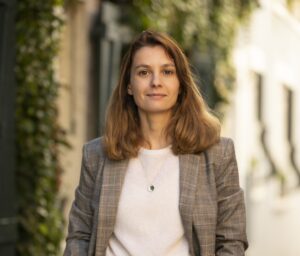 Emmanuelle Picaud is an independent investigative journalist based in France.
Her work focuses on environment, urbanism, green finance and topics linked with the use of public or private funds. She combines traditional investigative techniques—such as freedom of information requests, company and court reports, and leaks—with data-driven methods, including trade data analysis, financial databases, OSINT, and satellite imagery. She has collaborated in the past with journalists’ consortiums on cross-border investigations.
In 2023, Emmanuelle coordinated the European investigation “Cashing in on Carbon Credits”, a series of reports uncovering how companies in the cement and steel industries profited from free emission allowances on the European carbon market, generating billions in windfall gains. Academically, she holds a Masters degree in Journalism, as well as a Masters in Urban Planning and a Bachelor’s degree in Philosophy. She regularly contributes to specialized publications related to these fields.
Her work has been featured in national and international outlets such as Le Monde (France), the BBC (UK), El Diario.es (Spain), TagessSpiegiel (Germany), Irpi Media (Italy) or Le Temps (Switzerland).
Emmanuelle researched the conflicts of interest that arise from the dominance of the Big 4 accounting firms and their influcence in the negotiations shaping the EU’s Corporate Sustainability Reporting Directive. The resulting article was published by DeSmog on 17 November.
 Raluca Besliu is an independent journalist originally from Romania. She has previously lived and worked in West Africa, Germany, and the United States. She has mostly worked in written journalism, publishing articles on topics ranging from environmental and political affairs in Eastern Europe to human rights abuses in African countries.
One particularly impactful investigation examined TotalEnergies’ inadequate response to oil spills affecting Nigerian farming communities, work that earned the 2023 Hostwriter Story Prize.
In 2024, she also worked on a cross-border investigation exploring the increasing criminalization of environmental activists engaged in so-called “eco-vandalist” actions, specifically those targeting works of art – across France, Germany, and Italy. A key focus of this investigation was analyzing the rise in surveillance tactics and documenting the chilling effects these measures have had on activist movements. The research, published in The Parliament Magazine (in English) and in Lokko Magazine (in French), revealed how groups like Last Generation have been compelled to move away from disruptive actions due to intensified state monitoring.
Raluca investigated the supposedly sustainable second-hand clothes industry in Europe and uncovered an environmentally damaging and carbon-intensive network of exports to the Global South and in some cases back again. The articles from this research were published 27-28 November by Follow-The-Money (in English), by Ara15 in Catalan, and by ARIJ (in Arabic).
Partners
